>>
Industry>>
EdTech>>
Code Review in Distributed Dev...Code Review in Distributed Development Teams: Where Quality Control Quietly Breaks
The Silicon Review
25 February, 2026
Author:
The Silicon Review Team
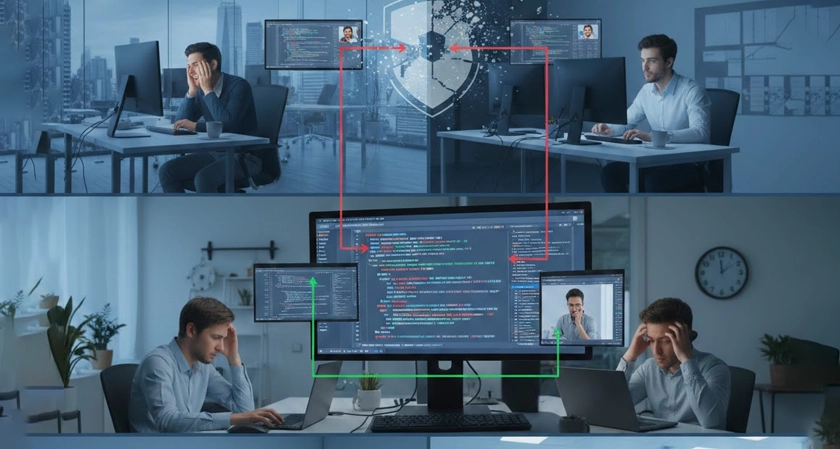
Distributed development is no longer an exception. For many companies, it is the default. Teams work across time zones, cultures, and contracts. Code moves fast, sometimes faster than understanding.
In this environment, teams often rely on code review as a service not because they lack internal engineers, but because internal processes stop scaling once ownership becomes blurred. The need is less about syntax or style and more about consistency, accountability, and shared understanding.
This article looks at code review specifically in distributed and partially outsourced teams, where quality issues tend to appear slowly and then all at once.
Why Distributed Teams Change the Meaning of Code Review
In a small, co-located team, code review is often informal. People know each other’s habits. Context lives in conversations. Mistakes are caught early, sometimes even before code is written.
Distributed teams work differently.
Communication is asynchronous. Decisions are documented poorly or not at all. Engineers join and leave without ever meeting. Under these conditions, code review stops being just a quality gate. It becomes a knowledge transfer mechanism.
That shift is often underestimated.
The Hidden Risk: Code Without Shared Context
Most quality issues in distributed teams are not caused by bad engineers. They come from missing context.
Common symptoms include:
- Code that technically works but violates architectural intent
- Repeated implementation of the same logic in different places
- Overengineering in some modules and shortcuts in others
- Defensive coding caused by lack of trust in upstream components
A code review that focuses only on correctness will miss these patterns.
Why Pull Requests Alone Are Not Enough
Modern tooling makes reviews easy to run, but not easy to do well.
In distributed teams, reviewers often:
- Skim changes instead of understanding them
- Focus on formatting or naming
- Approve quickly to avoid blocking progress
Over time, this creates a false sense of safety. The system looks reviewed, but structural problems keep growing.
A deeper form of code review looks beyond individual pull requests and asks how changes fit into the system as a whole.
Code Review as a Stabilizing Force
When teams are distributed, consistency matters more than elegance.
Effective reviews help enforce:
- Architectural boundaries
- Shared coding conventions
- Reusable patterns instead of local solutions
- Predictable error handling and logging
Without this, every new contributor subtly reshapes the system. Not intentionally, just naturally.
What Makes Code Review Harder in Distributed Setups
Asynchronous feedback loops
Delayed feedback changes behavior. Developers are more likely to:
- Defend their implementation instead of improving it
- Avoid touching risky areas
- Copy existing patterns even if they are flawed
Code review must adapt to this reality, or it becomes a checkbox.
Uneven experience levels
Distributed teams often mix senior and junior engineers across vendors or locations. Reviews then serve two purposes at once:
- Quality control
- Skill alignment
If handled poorly, this creates friction. If handled well, it becomes an onboarding accelerator.
Ownership gaps
In long-running distributed projects, nobody fully “owns” the codebase anymore.
A strong code review process compensates for this by acting as a shared memory. Decisions live in review discussions, not just in code.
What a Mature Code Review Looks Like
A useful code review process is predictable. Not perfect, predictable.
It usually includes:
- Clear expectations for reviewers
- Defined scope (what is reviewed, what is not)
- Focus on impact, not just implementation
- Documentation of non-obvious decisions
This structure matters more than tooling.
Review Depth vs. Review Frequency
Not all code deserves the same level of scrutiny.
Mature teams differentiate between:
- Low-risk changes (config, minor refactors)
- Business-critical logic
- Infrastructure or security-related code
Trying to review everything equally leads to fatigue. Fatigue leads to shallow reviews.
When External Review Makes Sense
Internal reviews are shaped by internal habits. That is not a flaw, just a limitation.
External reviewers can help when:
- The team normalized risky patterns
- Internal reviewers are overloaded
- The system evolved faster than documentation
- Technical debt discussions became political
Some organizations occasionally involve external partners like DevCom in this role, mainly to introduce a neutral technical viewpoint rather than to replace internal expertise.
Code Review as a Learning Channel
In distributed teams, code review is one of the few places where learning scales.
Good reviews:
- Explain why, not just what
- Reference system-level implications
- Encourage simpler solutions
- Create shared vocabulary
Poor reviews only say “fix this” or “rename that.” Over time, that difference compounds.
Common Code Review Failure Modes
Even well-intentioned processes fail.
Typical issues include:
- Overemphasis on style rules
- Personal preferences disguised as standards
- Lack of follow-up on repeated issues
- Reviews done too late in the development cycle
When developers stop learning from reviews, quality stops improving.
Measuring Code Review Effectiveness
The impact of code review is not visible immediately.
Better indicators include:
- Reduced rework in later stages
- Fewer recurring defects in the same areas
- More consistent architecture over time
- Shorter onboarding for new developers
If none of these improve, the process likely needs adjustment.
Integrating Code Review Into Daily Work
The most effective teams treat code review as part of development, not a gate at the end.
This means:
- Smaller, more focused changes
- Reviews happening early
- Shared responsibility for outcomes
- Time explicitly allocated for reviewing
Without time, reviews degrade. Always.
Why Code Review Still Matters in 2026
Automation is improving. AI tools flag issues faster than humans. That helps.
But tools do not understand trade-offs. They do not know which complexity is acceptable and which one will hurt in six months.
That judgment still lives in human review.
Especially in distributed teams, code review remains one of the few practices that align people who rarely talk to each other.
Conclusion: Code Review as a System, Not a Ritual
In distributed development, quality rarely collapses suddenly. It erodes quietly.
A thoughtful code review process slows that erosion. Not by catching every bug, but by creating shared understanding across distance, time zones, and contracts.
When treated as a learning and alignment mechanism rather than a formality, code review becomes one of the strongest stabilizing forces in modern software development.
And for teams that expect their systems to live for years, that stability matters more than speed.