>>
Industry>>
Travel and hospitality>>
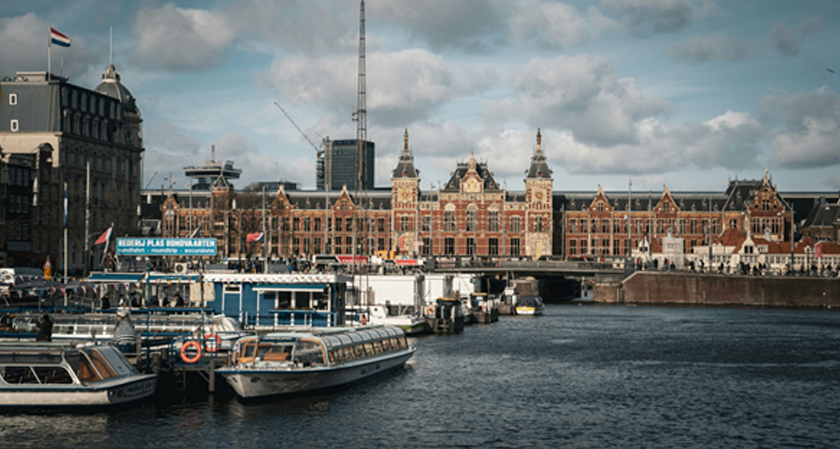
The Gothic Spires of Amsterdam...The Gothic Spires of Amsterdam Centraal and the Iron Lace of Gare du Nord: Engineering Elegance
The Silicon Review
26 February, 2026
Author:
The Silicon Review Team
Railway stations often serve as more than transit points. They hold the outline of a city’s ambition at the moment it first turned decisively toward movement. In Amsterdam and Paris, two nineteenth-century stations rise not simply as infrastructure, but as statements in brick and iron.
Amsterdam Centraal gathers its silhouette in layered towers and pointed forms. Gare du Nord spreads its ironwork outward beneath a broad façade. Both were built to manage flow. Both continue to do so, though the elegance remains embedded in their surfaces.
Brick and Turrets at the Water’s Edge
Amsterdam Centraal stands close to the IJ, its red-brick façade punctuated by towers that echo Gothic revival forms. From a distance, it appears almost civic rather than industrial. Spires and gables rise above the tracks, creating a skyline that blends into the historic core of the city.
Morning light catches the brick unevenly, warming some surfaces while leaving others in shadow. Cyclists pass along the forecourt in steady rhythm. Ferries move quietly behind the station, reinforcing its role as threshold between land and water.
Many departures begin here, including journeys on the train from Amsterdam to Paris, where platforms extend beneath arched roofing before narrowing into horizon. The transition from station hall to carriage feels contained. Brick and stone give way to glass and countryside.
Inside, the vaulted ceilings carry sound upward, dispersing the murmur of announcements and footsteps. The structure feels both decorative and deliberate.
Iron Framed in Light
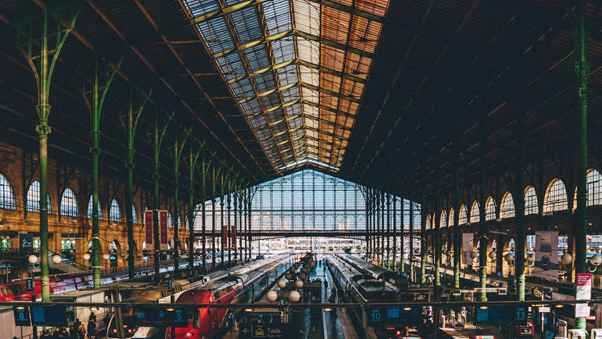
Gare du Nord presents a different material language. Its façade holds classical statuary and stone relief, yet beyond the entrance, iron arches stretch across platforms in repeating spans. The framework appears almost delicate from a distance, though it supports immense weight.
Light filters through high glazing, scattering across tracks and polished surfaces. The scale is immediate. Trains enter and depart in layered sequence, their motion framed by iron ribs that form a lattice overhead.
Travellers connecting through continental routes — whether continuing from a Prague to Vienna train further east or arriving from the north — encounter a station that balances ornament and efficiency. The ironwork does not dominate; it structures.
Standing beneath the canopy, you notice how geometry defines the space. Lines converge and diverge. Steel beams meet at precise angles. The repetition becomes rhythm.
Structure as Ornament
Amsterdam’s station relies on brick and vertical emphasis to achieve distinction. Paris leans on iron and span. Yet both reveal a moment when engineering and aesthetics intertwined rather than diverged.
In Amsterdam, detail accumulates in façade — carved stone, narrow windows, stepped roofs. In Paris, ornament resides within structure itself — the curve of metal arch, the sweep of glass panel.
Weather alters perception in each. Rain deepens Amsterdam’s brick to a darker red. In Paris, cloud softens the contrast between iron and sky. Neither loses coherence.
Between Platforms and Borders
Travel between northern and western Europe compresses distance into a series of departures and arrivals. The shift from canal-lined streets to Parisian boulevards occurs in measured increments.
From a carriage window, fields pass in subdued tones. Station roofs appear briefly before receding again. The memory of one façade lingers as another comes into view.
Inside both stations, movement persists without urgency. Commuters, tourists, workers — all fold into the same flow beneath spire or iron arch.
When Departure Pauses
As evening gathers, Amsterdam Centraal’s towers darken against a dim sky. Interior lights glow warmly behind tall windows. In Paris, iron beams silhouette beneath artificial illumination, their structure more visible than their surface.
Later, recalling the two, brick and iron align in recollection — vertical and horizontal, pointed and arched. The distinction remains clear, yet the shared purpose connects them.
Neither station resolves into nostalgia. They continue to carry trains and passengers forward. Engineering remains visible, elegance embedded within function. Spire and lattice hold their form beneath shifting light, steady at the edge of departure.









-Recovered-Recovered-Recovered_2026-07-25_10-24-34.webp")

-Recovered-Recovered-Recovered_2026-07-25_10-03-12.webp")