>>
Industry>>
Nanotechnology>>
'Nano-Origami' Reshapes Liquid...'Nano-Origami' Reshapes Liquid Droplets into Six-Pointed Stars
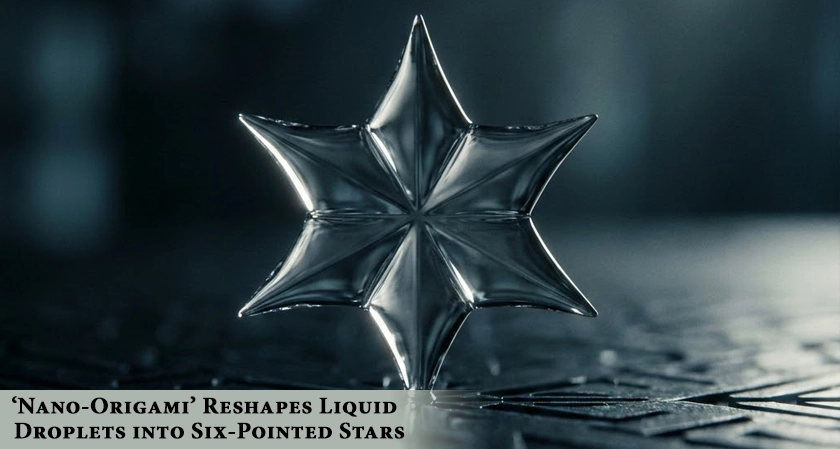
Scientists have developed a "nano-origami" technique that reshapes liquid droplets into precise six-pointed star formations using DNA and gold nanoparticles.
Researchers have unveiled a revolutionary "nano-origami" technique that transforms liquid droplets into intricate six-pointed star shapes at the microscopic level. The method, developed by an international team of scientists, uses DNA strands and gold nanoparticles to fold liquid structures with unprecedented precision.
The nano origami technique works by attaching DNA "hinges" to gold nanoparticles suspended within liquid droplets. When triggered by specific chemical signals, the DNA strands fold in predetermined patterns, forcing the surrounding liquid to reshape accordingly. The result is a stable, six-pointed star formation that maintains its structure for extended periods.
"This is like origami, but at a scale 10,000 times smaller than a human hair," explained the lead researcher. "We're essentially programming liquids to remember specific shapes, which open entirely new possibilities for material design. “That’s why it got its name nano origami.
The six-pointed star shape is particularly significant because it demonstrates the ability to create complex, symmetrical patterns rather than simple spherical droplets. The researchers achieved this by carefully controlling the placement and folding sequence of 24 distinct DNA hinges arranged in a radial pattern around a central gold nanoparticle core.
Applications for the technology span multiple fields. In drug delivery, precisely shaped particles could be designed to lodge in specific tissues or release medications at controlled rates. In optics, star-shaped liquid structures could manipulate light in novel ways. The technique also holds promise for creating "programmable matter" materials that can change their physical properties on demand.
The research team plans to expand the technique to create additional shapes, including cubes, spirals, and branching structures. They are also working to make the process reversible, allowing shapes to form and dissolve repeatedly.
The work was funded by grants from the National Science Foundation and the European Research Council, with findings published in the Nature Nanotechnology journal.