>>
Technology>>
Artificial intelligence>>
AMD CEO’s Meeting With China...AMD CEO’s Meeting With China’s Vice-Premier Raises Optimism about US AI Chip Imports
The Silicon Review
20 May, 2026
Author:
Sashindra Suresh
China's robotics industry is accelerating as technological breakthroughs and abundant funding drive expansion. The Silicon Review reports on 20 percent annual growth and shifting dynamics between foreign and domestic manufacturers.
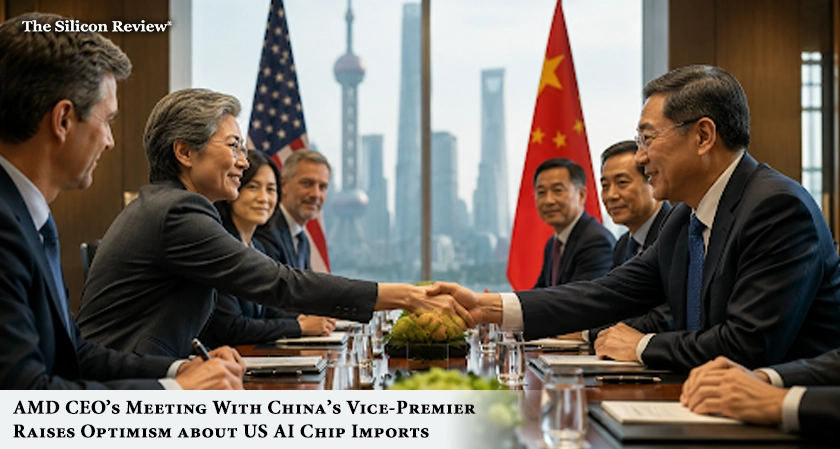
Optimism is rising in China’s semiconductor industry after the chief executive of Advanced Micro Devices held talks with China’s vice-premier during a high-level meeting focused on artificial intelligence cooperation and semiconductor trade. The discussions signaled a potentially softer tone in ongoing US-China technology tensions and renewed hopes among Chinese firms for improved access to advanced AI chips.
China’s technology sector has faced mounting restrictions on imports of high-performance AI semiconductors following export controls introduced by the United States in recent years. Those measures affected shipments of advanced graphics processing units and AI accelerators from major American chipmakers including AMD and NVIDIA. Chinese cloud providers, AI startups, and research institutions have since accelerated efforts to develop domestic alternatives.
Industry observers say the AMD meeting reflects growing recognition from both sides that complete technological decoupling would damage global supply chains and slow AI innovation. Chinese officials reportedly emphasized the importance of maintaining stable semiconductor trade relations, while AMD executives highlighted China’s importance as one of the world’s largest markets for data center and AI hardware.
The meeting has triggered cautious optimism among Chinese semiconductor importers and AI companies that licensing approvals for certain AI chips could become more predictable in the coming months. Analysts believe US suppliers may seek expanded permissions to sell downgraded AI accelerators that comply with export regulations while still meeting demand from Chinese customers.
China’s domestic semiconductor industry continues to invest heavily in reducing reliance on foreign technology. State-backed funding for AI chips, advanced manufacturing equipment, and semiconductor materials has surged since 2023. Companies including Huawei Technologies, Biren Technology, and Cambricon Technologies are expanding research into locally designed AI processors aimed at competing with US products.
Despite progress, China still depends on imported high-end chips for training large AI models and powering advanced cloud computing infrastructure. Domestic chipmakers continue to face challenges in manufacturing efficiency, advanced lithography access, and software ecosystem development compared with established US rivals.
Analysts note that any relaxation in semiconductor trade would likely remain limited and carefully controlled under existing US national security frameworks. However, the AMD discussions are being viewed as an important diplomatic and commercial signal that dialogue between Washington-linked technology firms and Beijing remains active even amid broader geopolitical competition.
The semiconductor market reaction was moderately positive, with investors interpreting the meeting as evidence that selective cooperation in artificial intelligence and advanced computing may continue despite ongoing export restrictions and policy uncertainty.
Q: Why is AMD’s meeting with China’s vice-premier significant?
A: The meeting is viewed as a positive signal for semiconductor trade relations and has raised hopes that Chinese companies may gain more predictable access to certain US AI chips.
Q: Which US export controls have affected China’s AI industry?
A: US restrictions on advanced AI semiconductors and high-performance GPUs have limited Chinese access to cutting-edge chips used for AI training and cloud computing.
Q: Which Chinese companies are developing domestic AI chips?
A: Major Chinese firms investing in AI processors include Huawei, Biren Technology, and Cambricon Technologies.
Q: Why does China still rely on imported AI chips?
A: Domestic manufacturers still face challenges in advanced chip manufacturing, lithography technology, and software ecosystems needed for high-end AI computing.
Q: What could happen if semiconductor trade tensions ease?
A: Analysts say Chinese firms could receive more stable access to compliant AI chips, while global semiconductor supply chains and AI development could benefit from reduced uncertainty.







_2026-06-24_13-28-21.webp")


_2026-06-24_12-35-51.webp")