>>
Technology>>
Cyber security>>
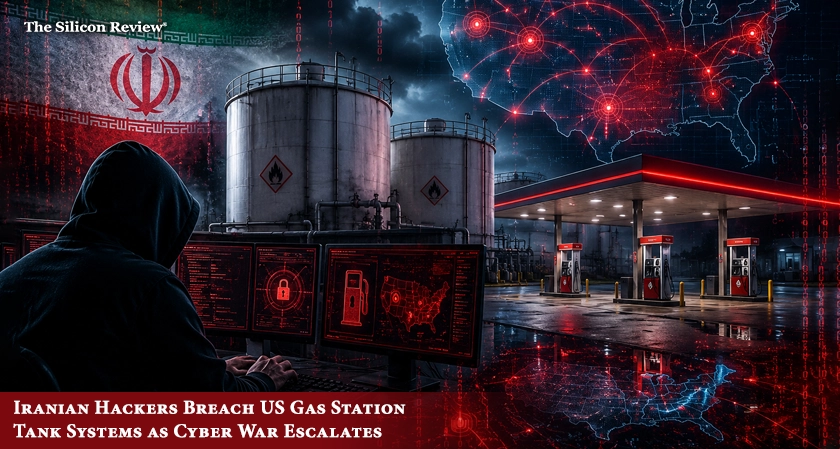
Iranian Hackers Breach US Gas ...Iranian Hackers Breach US Gas Station Tank Systems as Cyber War Escalates
The Silicon Review
16 May, 2026
Author:
Sashindra Suresh
Iranian hackers breached automatic tank gauges at US gas stations across multiple states. The Silicon Review reports on the unprotected systems, safety risks, and Tehran's escalating cyber war against American critical infrastructure.
Suspected Iranian hackers have breached automatic tank gauge systems at gas stations across multiple US states, exploiting internet-facing industrial devices left unprotected without passwords. The intrusions, confirmed by multiple sources briefed on the investigation, have allowed attackers to manipulate fuel level display readings but not alter actual fuel quantities stored in underground tanks.
The compromised ATG systems represent a critical vulnerability in America's fuel supply chain. While no physical damage or harm has been reported, access to an ATG could theoretically allow a hacker to mask a gas leak, preventing detection until environmental or safety consequences escalate. Cybersecurity researchers & the federal government have warned about exposed ATG systems for over a decade, yet many infrastructure operators have failed to implement basic password protections.
Iran has a documented history of targeting ATG systems. In 2015, security firm Trend Micro placed mock ATG systems online as honeypots; a pro-Iranian group quickly surfaced to attack them. Since the US-Israeli war with Iran began in late February, Tehran-linked hackers have caused disruptions at multiple US oil, gas, & water facilities, leaked FBI Director Kash Patel's private emails, & caused shipping delays at medical device maker Stryker.
The current campaign against ATG systems is part of a broader, accelerating Iranian cyber offensive. The FBI, CISA, NSA, EPA, Department of Energy, & US Cyber Command jointly warned on April 7, 2026, that Iranian-affiliated advanced persistent threat actors are actively exploiting internet-facing industrial control systems across US critical infrastructure. PwC's threat intelligence director noted that Iranian cyber operations are advancing at "a faster iteration speed with more layers of hacktivist personas, & possibly AI-expanded reconnaissance & attack."
The breach also carries political implications for the Trump administration. The Iran war has already driven gasoline prices higher, with 75 percent of US adults surveyed in a recent CNN poll saying the conflict has negatively affected their finances. Confirmed Iranian cyberattacks on domestic fuel infrastructure could further inflame public sentiment.
The ATG breach campaign follows a predictable escalation trajectory from Iranian cyber actors. Between 2020 and 2022, groups like CyberAv3ngers focused on propaganda and defacement. By late 2023, they were exploiting default credentials on Israeli-made Unitronics PLCs, compromising at least 75 devices across the US, Israel, the UK, & Ireland. In mid-2024, the group deployed IOCONTROL, a custom-built Linux malware platform targeting routers, PLCs, HMIs, firewalls, & fuel management systems. The current phase pivoted to exploiting CVE-2021-22681, a critical authentication bypass in Rockwell Automation Logix controllers with no available patch & a CVSS score of 9.8.
By the third quarter of 2026, security analysts expect Iranian cyber actors to target additional industrial control system vendors beyond Unitronics & Rockwell Automation, potentially expanding to Schneider Electric & Siemens PLCs. The convergence of Tehran's demonstrated capability to manipulate fuel monitoring systems, active kinetic hostilities between the US and Iran, and the approaching US midterm elections creates the most acute Iranian cyber threat to American critical infrastructure on record.
The Silicon Review's analysis indicates that systemic exposure condition enabling these attacks internet-exposed industrial control systems with weak or default authentication is structural, not transient. It has persisted across every phase of Iranian cyber operations despite repeated federal advisories. An estimated 60+ pro-Iranian hacktivist groups have now adopted the same ICS exploitation techniques, creating a distributed threat surface with no single point of disruption.
Q: What is an automatic tank gauge (ATG) and why would hackers target it?
A: An automatic tank gauge (ATG) is a device at gas stations that monitors fuel levels in underground tanks. Hackers target ATGs because manipulating the readings can hide fuel theft, mask environmental leaks, or cause supply disruptions without physically touching the equipment.
Q: What automatic tank gauge (ATG) systems were breached by suspected Iranian hackers?
A: ATG systems used at gas stations to monitor fuel levels in underground storage tanks. The systems were connected to the internet without password protection, allowing hackers to manipulate display readings.
Q: Could the Iranian hackers cause physical damage or gas leaks?
A: No physical damage has been reported, but access to an ATG could theoretically allow a hacker to make a gas leak go undetected by manipulating the monitoring system while the leak continues.
Q: How many US states were affected by the Iranian cyber breaches?
A: Multiple US states were affected, though officials have not disclosed the exact number. The breaches targeted gas stations across several states where ATG systems were left exposed online.
Q: Why do US officials suspect Iran despite limited forensic evidence?
A: Iran has a documented history of targeting ATG systems dating back to 2015. IRGC internal documents from 2021 specifically identified ATGs as potential cyberattack targets for disrupting gas stations.
Q: How has Iran's cyber capability against US infrastructure evolved since 2023?
A: Iran has progressed from default credential exploitation (2023) to custom ICS malware (2024) to actively exploiting critical authentication bypass vulnerabilities in Rockwell Automation PLCs with no available patch (2026).
Q: What should US infrastructure operators do to protect against Iranian cyber-attacks?
A: Operators must remove internet-exposed industrial devices, implement strong password authentication, apply defense-in-depth mitigations, and assume that Iranian actors will continue probing for unprotected ATG and PLC systems.