>>
Technology>>
Science and technology>>
World‘s First Titanium-Coppe...World‘s First Titanium-Copper Medical Implant Unveiled in China to Cut Infection Risk
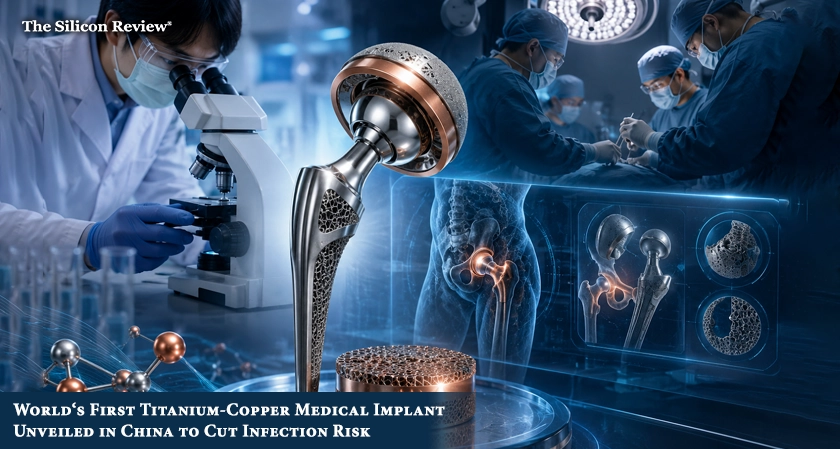
Chinese scientists unveiled the world’s first titanium-copper medical implant designed to actively kill bacteria. The Silicon Review reports on the breakthrough that could slash post-surgical infections without antibiotics.
Chinese scientists have unveiled the world‘s first titanium-copper medical implant, a breakthrough designed to actively kill bacteria and dramatically reduce post-surgical infection rates without relying on antibiotics.
The implant, developed by researchers at the Chinese Academy of Sciences’ Institute of Metal Research, incorporates copper ions into a titanium matrix. Copper has natural antimicrobial properties that disrupt bacterial cell membranes and DNA, but embedding it in titanium the standard material for orthopaedic and dental implants has historically proved challenging due to copper‘s tendency to weaken metal structures.
The team solved this by developing a novel manufacturing process called selective laser melting, which creates microscopic copper-rich regions within the titanium matrix without compromising mechanical strength. The resulting material kills up to 99 percent of Staphylococcus aureus and Escherichia coli bacteria within six hours of contact.
Titanium-copper medical implant technology addresses a growing crisis in global healthcare. Surgical site infections affect up to 3 percent of patients in developed countries and up to 20 percent in developing nations, according to World Health Organization data. Each infection adds an average of $20,000 to treatment costs and increases the risk of implant failure, amputation, and death.
The Chinese team has already completed animal studies showing that the titanium-copper implants integrated successfully with bone tissue while maintaining significantly lower infection rates than conventional titanium controls. Human trials are scheduled to begin in June 2026 at three major hospitals in Shanghai, Beijing, and Guangzhou.
The breakthrough is particularly significant for developing countries, where post-surgical infections are more common due to limited access to sterile operating environments and prophylactic antibiotics. Unlike antibiotic coatings, which lose effectiveness as the drug diffuses away, the titanium-copper implant‘s antimicrobial properties are intrinsic and last for the lifetime of the device.
By the second quarter of 2027, the team expects to submit the titanium-copper implant for regulatory approval from China‘s National Medical Products Administration, with commercialization targeted for late 2027. The researchers are also exploring applications in dental implants, spinal fusion devices, and trauma fixation plates.
The Silicon Review‘s analysis indicates that the titanium-copper implant represents a paradigm shift in infection prevention: from chemical warfare antibiotics that bacteria inevitably learn to resist to physical warfare copper ions that bacteria have no evolutionary defense against. If human trials succeed, the technology could become the new standard for millions of implant surgeries performed globally each year.
Q: What is the titanium-copper medical implant?
A: It is a medical implant made from titanium infused with copper ions using a novel manufacturing process. Copper has natural antimicrobial properties that kill bacteria, while titanium provides the mechanical strength needed for orthopaedic and dental implants.
Q: How effective is the titanium-copper implant at killing bacteria?
A: The material kills up to 99 percent of Staphylococcus aureus and Escherichia coli bacteria within six hours of contact, according to laboratory tests conducted by the Chinese research team.
Q: What surgical site infection rates are addressed by this technology?
A: Surgical site infections affect up to 3 percent of patients in developed countries and up to 20 percent in developing nations. Each infection adds approximately $20,000 to treatment costs and increases the risk of implant failure, amputation, and death.
Q: When will human trials for the titanium-copper implant begin?
A: Human trials are scheduled to begin in June 2026 at three major hospitals in Shanghai, Beijing, and Guangzhou.
Q: How is the titanium-copper implant different from antibiotic coatings?
A: Unlike antibiotic coatings, which lose effectiveness as the drug diffuses away, the titanium-copper implant‘s antimicrobial properties are intrinsic to the material and last for the lifetime of the device. Bacteria also cannot develop resistance to copper ions as they do to antibiotics.
Q: When might the titanium-copper implant become commercially available?
A: The team expects to submit the implant for regulatory approval by the second quarter of 2027, with commercialization targeted for late 2027. Applications include orthopaedic implants, dental implants, spinal fusion devices, and trauma fixation plates.