>>
Industry>>
Environmental sustainability>>
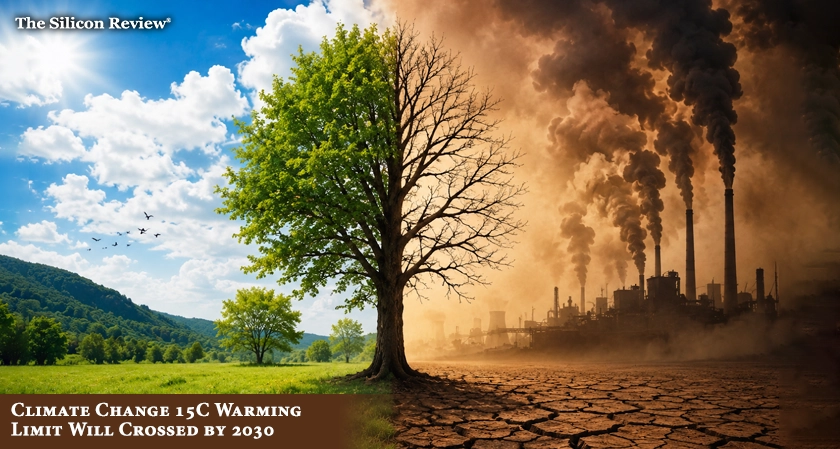
Climate Change Deadline 2030: ...Climate Change Deadline 2030: World Will Blow Past 1.5°C Limit. Governments Already Know. They Just Don't Care.
The Silicon Review
11 June, 2026
Author:
Sashindra Suresh
A new report warns the world will cross the 1.5°C warming limit by 2030 if emissions continue at current rates. The Silicon Review asks: when scientists have been screaming this for thirty years, why is anyone still pretending to be surprised?
The world will cross the 1.5°C warming limit by 2030. Not 2050. Not 2100. Four years from now.
If emissions continue at current rates, the carbon budget for staying under 1.5°C will be exhausted in 2029. That is not a prediction. That is arithmetic.
The report was published by leading climate scientists. The data is indisputable. The conclusion is terrifying. And the response from governments around the world will be exactly what it has always been. Nodding. Handwringing. Press releases. Then nothing.
Let us stop pretending. Climate scientists have been warning about the 1.5°C warming limit since the Paris Agreement in 2015. Before that, they warned about 2°C. Before that, they warned about sea levels, ice caps, and extinction events. Every warning was ignored. Every deadline was missed. Every promise was broken. And now the bill is coming due.
The 1.5°C limit is not arbitrary. It is the threshold beyond which climate impacts become catastrophic. Coral reefs die. Arctic sea ice collapses. Extreme heat waves become the new normal. Crop yields plummet. Millions are displaced.
Above 1.5°C, the risks escalate nonlinearly. Every tenth of a degree adds more damage than the last tenth of a degree. There are no safe levels beyond this point. Only degrees of devastation.
Here is the truth that no politician will say on television. Governments already know the 2030 deadline. They have known for years. They have the data. They have the models. They have the reports. They also have campaign donors, fossil fuel lobbyists, and electorates that refuse to pay for the transition.
So they do nothing. Or they do just enough to claim progress while emissions keep rising.
China is still building coal plants. The United States cannot stick to a climate plan for more than four years. Europe lectures everyone while burning natural gas shipped from elsewhere. India points at the West and says "you first." Every country has an excuse. Every country is right. Every country is wrong. And the carbon budget does not care who gets the blame. It only cares about the number. That number is running out.
Here is the uncomfortable question. If every country has an excuse, who is actually responsible? The answer is everyone. And no one. Collective action problems always end the same way. Collective inaction.
The 1.5°C warming limit was always a political target, not a physical one. Scientists said staying under 1.5°C was possible but required immediate, dramatic, global action. That action never came. Now staying under 1.5°C is not possible. Even the most optimistic scenarios overshoot.
The carbon budget for 1.5°C is about 250 billion more tons of CO2. Global emissions are about 40 billion tons per year. Do the division. Six years. Maybe seven if emissions start falling immediately.
They are not falling immediately.
So what happens when the world crosses 1.5°C? The Paris Agreement does not have enforcement mechanisms. There are no penalties. No courts. No global police. The target was always aspirational. Countries promised to try. They tried. They failed. Now they will try to adapt.
Adaptation is expensive. Sea walls. Relocation. Desalination. Air conditioning. Disaster response. The poor will suffer most. The rich will buy their way out of the worst impacts. That is not a solution. That is a continuation of the status quo.
As the world heads toward crossing the 1.5°C warming limit by 2030, The Silicon Review asks a final question. When scientists have been warning about climate change for three decades and governments have done almost nothing, what makes anyone think the next six years will be different?
FAQ:
Q: When will the world cross the 1.5°C warming limit?
A: The world will likely cross the 1.5°C warming limit by 2030 if emissions continue at current rates, exhausting the carbon budget in 2029.
Q: Why is the 1.5°C warming limit so important for climate change?
A: The 1.5°C limit is the threshold beyond which climate impacts become catastrophic, including coral reef death, Arctic ice collapse, and extreme heat waves.
Q: How much carbon is left in the budget for 1.5°C?
A: The remaining carbon budget for staying under 1.5°C is approximately 250 billion tons of CO2, about six years at current emission rates.
Q: Are global emissions decreasing or increasing?
A: Global emissions hit a record high in 2025, with coal, oil, and natural gas consumption still rising despite renewable energy growth.
Q: What happens when the world exceeds the 1.5°C warming limit?
A: There are no penalties under the Paris Agreement for exceeding the 1.5°C limit, and countries will shift focus from prevention to adaptation.
Q: Can the world still avoid crossing the 1.5°C warming limit?
A: Staying under 1.5°C would require immediate, dramatic global emissions reductions that are not currently happening, making overshoot likely.