>>
Industry>>
Defense technology>>
European Security Strategy Exp...European Security Strategy Exposed: Are Poland-Germany Relations Revealing Europe's Deepest Defense Divide?
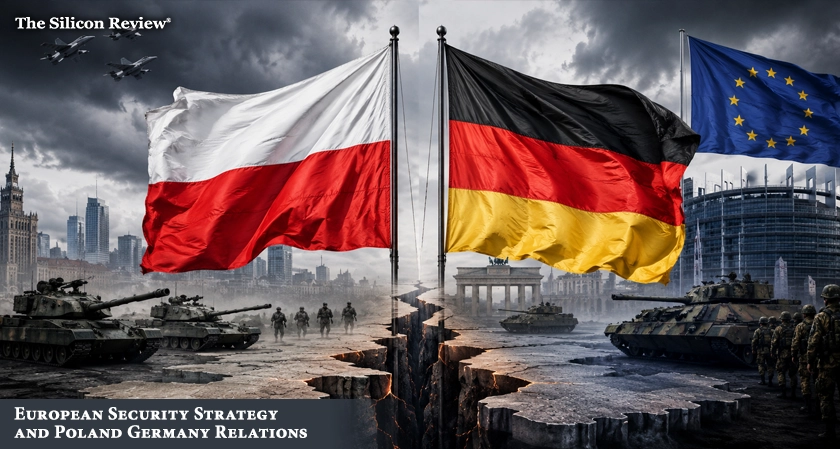
European Security Strategy Exposed: Poland and Germany are signing a new defense cooperation agreement, but the limited agreement highlights growing questions about European security strategy and how much trust European allies are willing to place in one another.
The deal appears more limited than some analysts and observers had anticipated. As European security strategy evolves amid Russian aggression and uncertainty surrounding the future scale of US military engagement in Europe, The Silicon Review asks: Is Europe building unity, or revealing its deepest divisions?
Poland and Germany are strengthening defense cooperation.
On Wednesday, June 17, 2026, officials from Warsaw and Berlin will sign a new package of security agreements marking the 35th anniversary of the Treaty of Good Neighbourship. The move comes as Poland deepens its military partnerships across Europe and seeks greater security certainty in an increasingly unstable geopolitical environment. But there is one striking omission.
Unlike Poland's recent defense agreements with France and the United Kingdom, the German deal does not introduce new security guarantees beyond existing North Atlantic Treaty Organization (NATO) and European Union commitments.
Europe continues to pursue strategic unity, while Poland's approach highlights the complexities involved in deeper defence cooperation.
The agreement's limited scope exposes a difficult question for Europe. If security threats are growing, why are some allies still unwilling to go further with defense commitments?
Part of the answer lies in politics. Part of it lies in history.
Despite decades of partnership, memories of Germany's World War II occupation of Poland continue to influence political debate and public perceptions. While Warsaw and Berlin cooperate closely through NATO and the European Union, trust remains a more complicated issue.
The real question is no longer whether Europe needs greater defense cooperation. The real question is whether Europe trusts itself enough to build it.
For Poland and Germany, the new agreement represents progress. For Europe, it may represent something more revealing.
As leaders promote closer cooperation and strategic autonomy, the limitations of this deal expose a difficult reality. Europe may agree on the threats it faces, but it still struggles to agree on how far mutual trust should go.
And in today's security environment, hesitation can be just as important as action.
FAQ:
Q: What is the new Poland-Germany defense agreement about?
A: The agreement focuses on security cooperation, including cyber security, Baltic Sea security, critical infrastructure protection, and military coordination.
Q: Why did Poland choose a more limited agreement?
A: Political sensitivities, domestic opposition, and historical concerns surrounding Germany influenced the decision.
Q: How does World War II still affect Poland-Germany relations?
A: Germany's occupation of Poland remains an important historical issue that continues to shape public opinion and political debates.
Q: Does this agreement replace NATO?
A: No. NATO remains the primary security alliance for both countries.













Comments