>>
Other>>
Politics>>
Iran's Missile attack Shakes...Iran's Missile attack Shakes US Bases across the Gulf. Is a Wider War Already Underway?
The Silicon Review
10 June, 2026
Author:
The Silicon Review Team
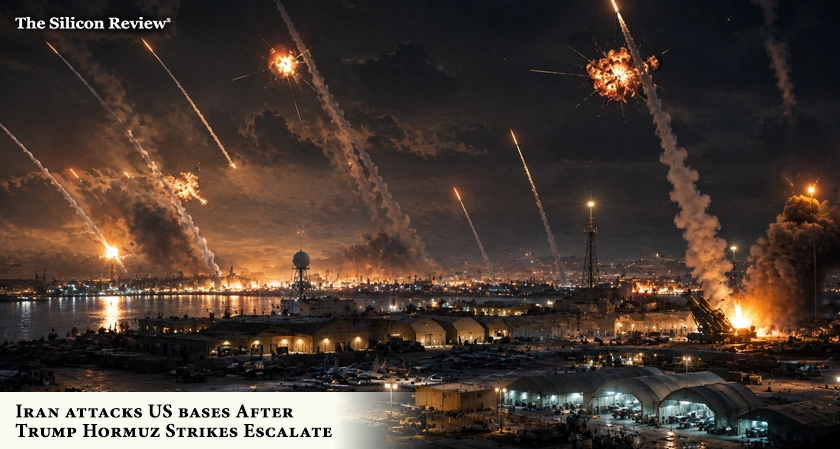
Iran Attacks US Bases in Jordan and across the Gulf after President Donald Trump ordered strikes on Iranian targets near the Strait of Hormuz. The Silicon Review asks: Both sides knew the risks. Both sides acted anyway. Has the ceasefire finally collapsed?
Iran attacks US bases after the United States carried out airstrikes on Iranian radar systems, air defenses, and military infrastructure. The strikes were ordered by President Trump and immediately shot down of US Apache helicopter near the Strait of Hormuz.
Within hours, Iranian missiles targeted American military facilities in Jordan, Kuwait, and Bahrain. US military officials confirmed incoming attacks and activated regional defense systems. Initial damage assessments remain limited, and casualty reports have not been officially confirmed.
Iran described its actions as retaliation for the American strikes, while Washington maintains that its operation was a response to Iranian aggression.
The Pentagon confirmed that multiple US bases were targeted. Several missiles were intercepted, while damage assessments remain ongoing. Iran says the attacks were retaliation for US strikes near Hormuz.
Both sides claim self-defense and blame the other for escalating the conflict.
The diplomatic standoff is over. Military action has begun.
The biggest concern now is the Strait of Hormuz, a narrow waterway that plays an outsized role in the global economy. Around one-fifth of the world's oil shipments move through this corridor every day. If tensions escalate and traffic is disrupted, the impact could be felt far beyond the Gulf; it has high chances of driving energy prices and putting additional pressure on governments, businesses, and consumers worldwide.
The United Nations might expect to hold emergency discussions as international leaders urge restraint. Yet history shows that retaliation often leads to more retaliation.
As Iran attacks bases across the Gulf and Washington weighs its next move, The Silicon Review asks one final question: If both sides expected retaliation, was this ever a failure of intelligence or a failure of diplomacy?
FAQ:
Q: What led to the US operation?
A: The reported downing of a US Apache helicopter near the Strait of Hormuz.
Q: Why did Trump order Hormuz strikes?
A: US officials linked the operation to the reported Apache helicopter incident.
Q: Could the conflict spread beyond the Gulf?
A: Analysts warn that continued retaliation could increase the risk of a wider regional confrontation.
Q: Which countries were affected of Iran Attacks?
A: Jordan, Bahrain, and Kuwait reported attacks or attempted strikes.