>>
Industry>>
Defense technology>>
NATO Defence’s Billion-Dolla...NATO Defence’s Billion-Dollar Question: Is Private Capital Becoming the New Weapon in the Global Security Race?
The Silicon Review
14 July, 2026
Author:
Jishnuu
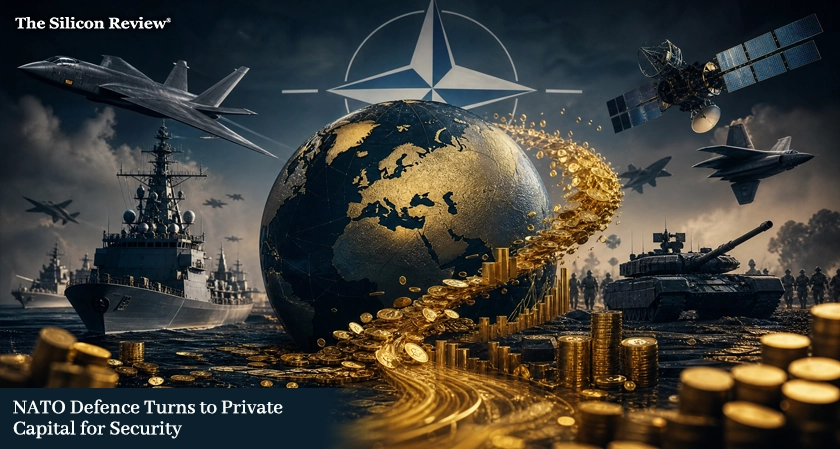
NATO is turning to banks and investors to accelerate defence production and military technology. Why does the world’s most powerful military alliance need private money to prepare for future conflicts?
NATO defence is entering a new financial battle as private capital joins the race to strengthen military power. If the alliance has massive resources, why does it need investors to prepare for tomorrow’s conflicts?
NATO is opening a new front in the global security race not with weapons, but with capital.
The alliance has launched a Call to Action to mobilise private investment for defence production, industrial resilience and military technology. The aim is to help defence companies expand faster and deliver the capabilities NATO needs for future threats.
Defence budgets are increasing, but industrial capacity is struggling to keep pace. Money can be approved overnight, but factories, supply chains and technology systems take years to build.
Is NATO facing a funding problem or a production problem that money alone cannot fix?
Following the Ankara summit, where allies faced pressure to boost defence spending, Citi joined the initiative, saying private finance will be critical to scaling defence production and accelerating military innovation.
“A strong and resilient Europe is in all our interests. Citi is proud to support NATO’s Call to Action and help mobilize the capital and financial expertise needed to strengthen the Alliance’s security for the long term,” said Nacho Gutiérrez Orrantia, Citi Europe CEO.
Citi argues that modern defence requires more than government budgets. It requires financing systems that allow companies to expand factories, secure supply chains and develop advanced military technologies.
Stephanie von Friedeburg, Global Head of Public Sector Group at Citi, said “The argument behind the NATO initiative is simple, higher defence budgets matter only if industry can deliver,”
Citi said it supports governments, defence ministries and NATO-aligned institutions through financing, procurement, payment infrastructure and liquidity solutions. The bank is also helping defence companies secure capital to expand production and strengthen capabilities.
Citi highlighted its continued presence in Ukraine, supporting government institutions and developing payment structures linked to defence deliveries and future reconstruction efforts.
Does private investment strengthen NATO defence or turn global insecurity into a profitable market?
Georgi Yordanov, Citi’s lead on Defence for Public Sector in Europe, said the key challenge is turning defence priorities into programmes that can be delivered.
NATO defence is no longer measured only by weapons and budgets, but by speed, innovation and industrial strength. The Silicon Review asks can private capital deliver security faster than rising threats, or is it exposing deeper gaps within the alliance?
FAQ:
Q: Why is NATO turning to private capital for defence?
A: NATO is seeking private investment to accelerate defence production, strengthen industrial capacity and support the development of advanced military technologies.
Q: What is NATO’s Call to Action?
A: It is an initiative encouraging banks, investors and financial institutions to support defence companies and improve allied military readiness.
Q: Why are higher defence budgets not enough?
A: Increased spending does not immediately create weapons, factories or supply chains. NATO needs stronger industrial capacity to convert budgets into real capabilities.
Q: How is Citi supporting NATO defence efforts?
A: Citi is providing financing, procurement support, payment infrastructure and liquidity solutions to governments, defence institutions and companies.
Q: What role does private finance play in military innovation?
A: Private capital helps defence companies expand production, secure supply chains and develop next-generation military technologies.
Q: Does private investment strengthen NATO security?
A: Private investment can improve defence readiness, but it also raises debate over the role of financial markets in national security.
Q: Why is industrial strength becoming important for NATO?
A: Modern security depends not only on weapons and budgets but also on manufacturing speed, innovation and resilient supply chains.




















Comments