>>
Other>>
Politics>>
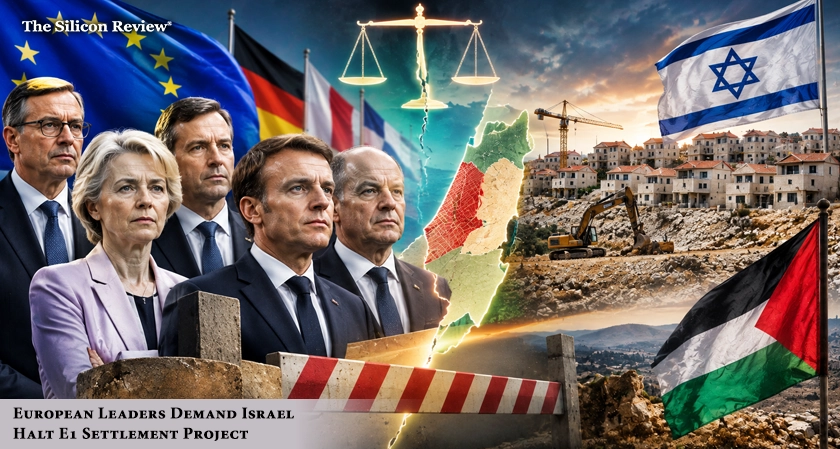
Six European Leaders Demand Is...Six European Leaders Demand Israel Halt E1 Settlement Project, Warning It Threatens Two-State Solution
The Silicon Review
21 August, 2026
Author:
Vinay Kumar
Leaders of six European nations have condemned Israel's E1 settlement project as "unacceptable," warning it threatens the two-state solution and urging Israel to retract the plans immediately.
Leaders of six European nations have issued a joint statement condemning Israel's decision to publish construction tenders for the controversial E1 settlement project in the West Bank, calling on the Israeli government to immediately retract the plans. The statement, released by the Elysee Palace, was signed by the leaders of France, Germany, Italy, the Netherlands, Norway, and Britain.
"The Israeli Government's decision to publish construction tenders for the E1 settlement project is unacceptable," the statement read.
"The international community has long opposed this settlement expansion, and has voiced their grave concerns privately and publicly."
The European leaders warned that the E1 project would "drive a wedge through the West Bank," harming the territorial contiguity of the Palestinian Territories and undermining the prospects for a two-state solution. They reaffirmed that Israeli settlements in the West Bank are illegal under international law and UN Security Council resolutions. The statement also warned businesses against participating in the construction tenders, citing potential legal and reputational consequences, including the risk of involvement in serious breaches of international law. The leaders noted that the decision came at a time of grave instability, marked by unprecedented levels of violence against civilians and severe restrictions on the Palestinian economy. The European response follows Israel's publication of a tender for 1,234 housing units in the E1 area, part of a larger plan for 3,401 homes. The E1 project has also drawn condemnation from Egypt and Jordan, while the EU is reportedly preparing a package of sanctions if construction begins.
"We urge the Government of Israel to retract these plans immediately and end its expansion of settlements in the West Bank. Not only will they take us further from peace, but they further undermine Israel's international standing," the statement said.
Here is the question this condemnation raises. Six European nations have condemned Israel's E1 settlement project, warning it threatens the two-state solution. When a long-controversial project moves from planning to tenders, can diplomatic pressure still halt its progress?
As Israel pushes ahead with the E1 project, The Silicon Review asks a final question. When the international community warns of legal consequences and sanctions, what will it take to change course on a project that has been stalled for decades?
FAQ:
Q: What is the E1 settlement project?
A: The E1 project is a controversial Israeli settlement plan in an area east of Jerusalem, between the city and the large settlement of Ma'ale Adumim. Critics warn it would divide the West Bank and make a contiguous Palestinian state impossible.
Q: Which European nations condemned the E1 project?
A: France, Germany, Italy, the Netherlands, Norway, and Britain issued a joint statement condemning the project and calling on Israel to retract its plans.
Q: Why is the E1 settlement project controversial?
A: The E1 project is controversial because it would create a continuous Israeli-controlled area between Jerusalem and Ma'ale Adumim, effectively severing the northern and southern parts of the West Bank and undermining the viability of a two-state solution.
Q: What actions has the EU threatened over the E1 project?
A: The EU is reportedly preparing a package of sanctions that could include labelling Israeli products, scaling down academic collaborations, and halting certain security and diplomatic collaborations if construction begins.
Q: What is the two-state solution?
A: The two-state solution is the internationally supported framework for resolving the Israeli-Palestinian conflict by establishing an independent Palestinian state alongside Israel, based on the 1967 borders with East Jerusalem as its capital.




















Comments