>>
Other>>
Politics>>
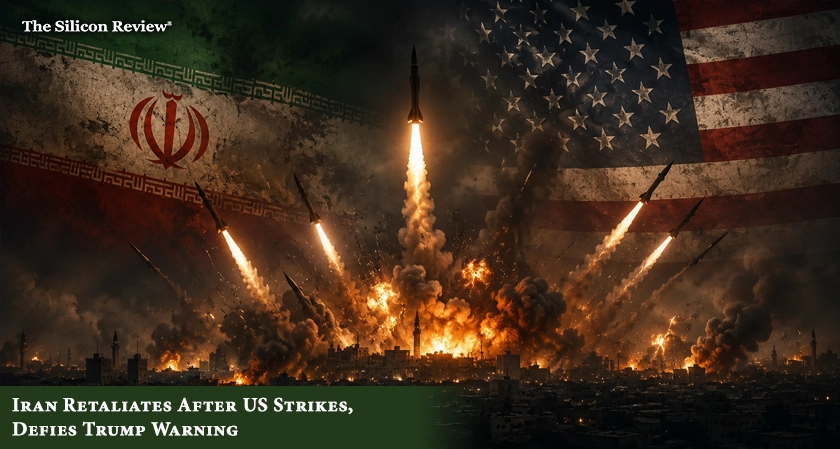
Iran Retaliates after US Strik...Iran Retaliates after US Strikes, Defying Trump’s Warning It Could Be Hit 'Much Harder'
The Silicon Review
02 September, 2026
Author:
Sashindra Suresh
Iran has launched ballistic missile and drone attacks on US bases in Jordan, Bahrain and Kuwait, defying President Trump's warning that any retaliation would see Iran hit "much harder" after American forces resumed strikes on Iranian targets near the Strait of Hormuz.
Iran has launched a series of retaliatory attacks against US military targets across the Middle East, defying a direct warning from President Donald Trump that any reprisal would be met with even greater force. The Islamic Revolutionary Guard Corps fired ballistic missiles at a US Marine base in Jordan's Aqaba and launched drones targeting radar systems and logistics areas at Sheikh Isa Air Base in Bahrain. Kuwait also activated its air defence systems to intercept hostile drones it said were linked to Iran.
"If the failed Nation of Iran retaliates for this very justified attack, they will be hit again at a much harder and higher level, but it will not be the biggest attack of them all, that is waiting in the wings and, when it is over, there will be very little left of the Islamic Republic of Iran!" Trump wrote on Truth Social.
The Iranian response came after the US carried out its first strikes on Iran since late July, targeting two IRGC missile launchers on Larak Island in the Strait of Hormuz. Washington said the strike was necessary because IRGC forces were preparing to launch rockets carrying sea mines into the strategic waterway. The Pentagon confirmed the fresh strikes, saying they targeted "air defense sites, radar systems, maritime assets and facilities, mine laying capabilities, and communications sites" associated with the IRGC. Trump described the operation as "large and powerful."
"The more the US military persists in its aggression in the region, the greater and heavier the losses it will have to endure." Iran's Armed Forces Central Headquarters said, according to state broadcaster IRIB.
The tit-for-tat strikes risk reigniting a full-scale military conflict that had been simmering for weeks. The latest round of attacks came as oil prices surged past $94 a barrel. Jordan confirmed it intercepted 13 ballistic missiles, with 10 destroyed and three falling in remote areas. Meanwhile, Iranian state media claimed a US missile strike hit a wedding celebration in southern Iran, killing five, including a child. The IRGC has vowed that the US will "regret" its attacks.
Here is the question this escalation raises. Iran has retaliated against US strikes despite Trump's explicit threat of "much harder" attacks. When both sides escalate despite warnings and the Strait of Hormuz remains a flashpoint, can the region avoid a full-scale war, or are we witnessing the breakdown of any remaining diplomatic path?
FAQ:
Q: What triggered the latest US strikes on Iran?
A: The US struck two Iranian missile launchers on Larak Island, claiming the IRGC was preparing to launch rockets with sea mines into the Strait of Hormuz, threatening commercial shipping.
Q: How did Iran retaliate?
A: Iran launched ballistic missiles at a US Marine base in Jordan and deployed drones against US targets in Bahrain. Kuwait also activated air defences to intercept Iranian drones.
Q: What did President Trump say about the US strikes?
A: Trump warned Iran that any retaliation would lead to "much harder and higher" attacks, and that an even larger strike was "waiting in the wings" that could leave "very little left of the Islamic Republic of Iran."
Q: Were there casualties in the strikes?
A: The US reported no casualties in the Iranian attacks. However, Iranian state media claimed a US strike hit a wedding celebration, killing five people, including a child.
Q: What is the status of the Strait of Hormuz?
A: The Strait of Hormuz remains a central flashpoint. The US said it has cleared sea mines from the strait, but Iran has effectively blocked shipping through the strategic waterway, disrupting global energy supplies.




















Comments