>>
Industry>>
Defense technology>>
Nuclear Weapons Are Back: 80...Nuclear Weapons Are Back: 80 years of Nuclear Deterrence Is a Lie: Countries Are Building More Nuclear Weapons Because They Expect to Use Them
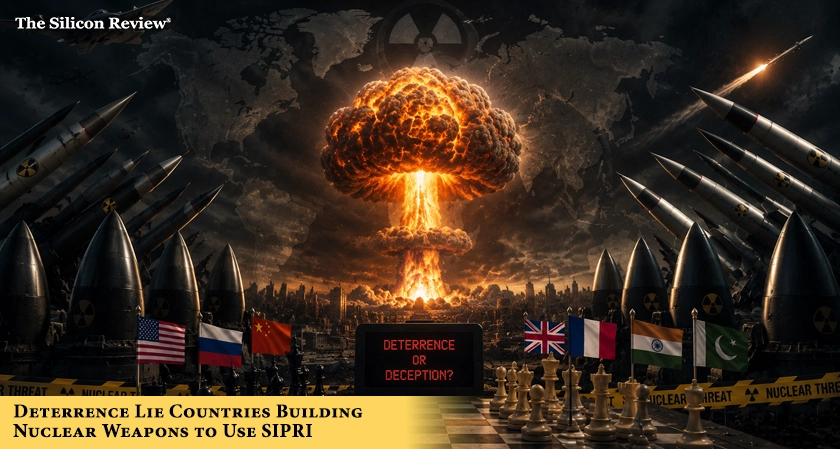
The world's nine nuclear powers are expanding and modernizing their arsenals while abandoning disarmament treaties says SIPRI study. The Silicon Review exposes the uncomfortable truth: deterrence is not keeping peace. It is just delaying the inevitable.
The Stockholm International Peace Research Institute (SIPRI) just released its annual Yearbook. The findings are dressed in academic language. Do not be fooled. They are a confession.
At the start of 2026, the world's nine nuclear powers possessed an estimated 12,187 nuclear warheads. Roughly 9,745 were ready for military use. Four thousand were already sitting on missiles and aircraft, ready to launch in minutes.
The total numbers dropped slightly. That drop happened because the United States and Russia finally finished dismantling old Cold War relics. Meanwhile, the number of operationally deployed warheads actually went up by about a hundred.
Let us stop lying to ourselves. Deterrence (to pause an action) theory says that if everyone has nuclear weapons, nobody will use them because everyone will be destroyed. That theory has a name. It is called Mutually Assured Destruction. The acronym is MAD. And MAD is not a strategy. It is a hostage situation.
Here is the truth that nobody in power wants to admit. If deterrence actually worked the way its defenders claim, countries would not be expanding their arsenals. They would be shrinking them. Confidently. Because the threat would already be sufficient.
Instead, the United States is spending an estimated $1.2 trillion on its "Golden Dome" missile defense program. President Donald Trump is pushing it hard. Costs are spiraling. The Pentagon cannot even give a final price tag.
Why would a country with 5,042 nuclear warheads need missile defense? Because deterrence alone does not feel safe enough.
China now has an estimated 620 warheads. That is up from basically nowhere a decade ago. Hundreds of new missile silos are going up in its northern provinces. By the end of this decade, China could have as many intercontinental ballistic missiles as Russia or the United States.
Russia is deploying the Oreshnik medium-range missile in Belarus. It keeps threatening nuclear escalation every time Ukraine gets new weapons from the West. Its new RS-28 Sarmat ICBM keeps failing tests, but it keeps trying.
Why would a country with the largest nuclear arsenal on Earth need a new missile that fails repeatedly? Because deterrence alone does not feel safe enough.
India and Pakistan actually fought a brief conflict in May 2025. Nuclear-armed neighbors. Shooting at each other. The world shrugged.
Here is the single question that destroys the entire deterrence argument. If nuclear weapons guarantee that major powers will not fight each other, why did India and Pakistan just fight each other? Why does NATO keep expanding toward Russia's border? Why does China keep building silos aimed at the United States?
The answer is uncomfortable. Deterrence does not prevent war. It just raises the stakes of the next one.
SIPRI Director Karim Haggag put it plainly: "Making national defense and security strategies dependent on nuclear weapons could significantly increase nuclear risks."
That is diplomatic language. Here is the translation. The world is building weapons it expects to use. Not for mutually assured destruction. For mutually assured threat. And threats have a way of escalating until someone tests the line.
The United Kingdom stopped publishing its warhead numbers and wants more F-35s to carry nuclear bombs. France is building new nuclear-armed hypersonic cruise missiles. Germany is signaling interest in French nuclear planning. North Korea has 60 warheads and is working on missiles to bypass missile defense.
Every single one of them will tell you they are building for peace through strength. Every single one of them is lying to themselves.
As the world's nuclear powers expand and modernize their arsenals while abandoning treaties, The Silicon Review asks a different question. Not whether deterrence works. But what happens the first time a leader decides it does not.
FAQ:
Q: How many nuclear weapons exist in the world right now?
A: The nine nuclear powers possess an estimated 12,187 nuclear warheads as of January 2026.
Q: Which country has the most nuclear weapons?
A: Russia leads with approximately 5,420 warheads, followed closely by the United States with 5,042 warheads.
Q: Did India and Pakistan actually fight a war despite both having nuclear weapons?
A: Yes, India and Pakistan fought a brief armed conflict in May 2025, directly contradicting deterrence theory predictions.
Q: What happened to the New START nuclear treaty between the US and Russia?
A: New START expired in February 2026 with no replacement treaty agreed upon, ending the last major US-Russia arms control agreement.
Q: Why is the US spending $1.2 trillion on missile defense if deterrence works?
A: The US is investing in missile defense because nuclear deterrence alone does not feel sufficient for national security planners.
Q: How fast is China expanding its nuclear arsenal?
A: China now has about 620 warheads and is expanding faster than any other nuclear power, with hundreds of new missile silos under construction.