>>
Industry>>
Supply chain management>>
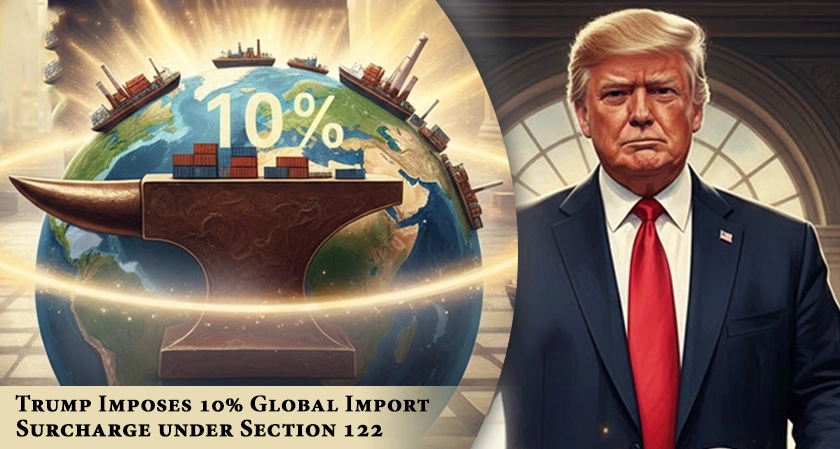
Trump Imposes 10% Global Impor...Trump Imposes 10% Global Import Surcharge under Section 122
The Silicon Review
21 February, 2026
Author:
The Silicon Review Team
President Trump invokes Section 122 of the Trade Act of 1974 to impose a 10% temporary import surcharge, citing a $1.2 trillion goods trade deficit and balance-of-payments concerns.
President Donald Trump has signed a proclamation imposing a 10% temporary import surcharge on most goods entering the United States, invoking Section 122 of the Trade Act of 1974 to address what the administration calls "fundamental international payments problems" . The action follows a Supreme Court ruling that struck down the administration's previous use of the International Emergency Economic Powers Act (IEEPA) to impose sweeping tariffs.
Effective February 24, 2026, the surcharge will remain in place for 150 days and applies ad valorem to articles imported into the United States. The White House cites a goods trade deficit of approximately $1.2 trillion in both 2024 and 2025, a current account deficit reaching 4.0% of GDP in 2024 the largest since 2008 and the first negative balance on primary income in over six decades. Officials argue these conditions threaten financial stability and investor confidence.
Section 122 authorizes the president to impose temporary import surcharges of up to 15% for 150 days when facing large and serious balance-of-payments deficits, without requiring prior congressional approval. The provision was enacted in 1974 as a rapid-response tool for short-term international financial instability.
Numerous exemptions apply based on "the needs of the U.S. economy.” Excluded products include critical minerals, energy products, pharmaceuticals, certain electronics, aerospace goods, and select agricultural items like beef, tomatoes, and oranges. Goods qualifying for duty-free treatment under the USMCA remain exempt, as do textile and apparel articles covered by the Dominican Republic-Central America Free Trade Agreement. Articles already subject to Section 232 national security tariffs will not face the additional surcharge.
The surcharge is treated as a regular customs duty and applies over and above existing tariffs. Goods in transit before February 24 that are entered by February 28 are exempt.
President Trump described the Supreme Court's IEEPA ruling as "deeply disappointing" but noted that "alternatives will be used" to maintain tariff revenue. The Office of the United States Trade Representative has been directed to begin fresh Section 301 investigations, signaling potential country-specific tariffs ahead.










-Recovered-Recovered-Recovered_2026-07-25_10-24-34.webp")

-Recovered-Recovered-Recovered_2026-07-25_10-03-12.webp")