>>
Industry>>
Fintech and Financial Services>>
WEF: Banks Face Money Launderi...FINTECH AND FINANCIAL SERVICES
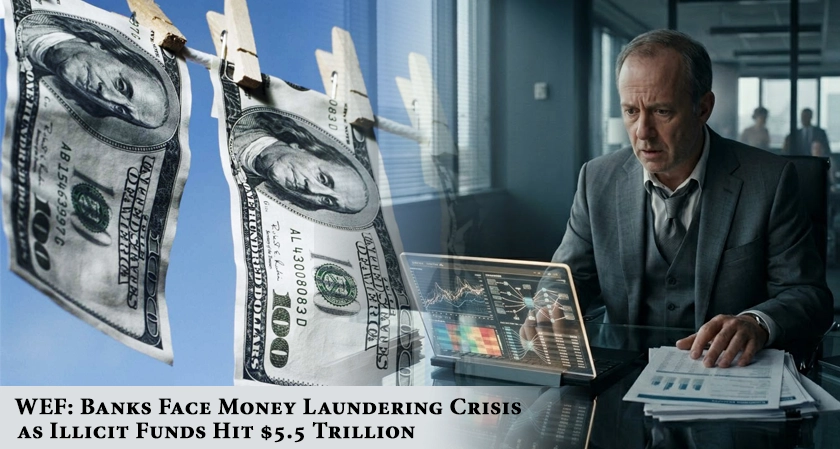
WEF: Banks Face Money Laundering Crisis as Illicit Funds Hit $5.5 Trillion
The Silicon Review
02 March, 2026
Author:
The Silicon Review Team
A World Economic Forum report warns banks are losing ground against money laundering as criminals exploit geopolitical instability with AI.
Financial institutions are losing ground in the fight against money laundering as criminals exploit geopolitical instability and technological advantages that legacy compliance systems cannot match, according to a new World Economic Forum report .
The analysis reveals that illicit funds flowing through global trade networks have reached $5.5 trillion annually, representing between 2% and 5% of worldwide GDP. In Europe alone, approximately $750 billion in illicit funds passed through the financial system in 2024, despite 75% of European compliance decision-makers reporting that regulatory requirements had intensified markedly during the same period.
The report, authored by Hassan Zebdeh, Financial Crime Advisor at Eastnets, examines how geopolitical tensions reshaping international commerce have created what he describes as a "chaotic, interconnected web" that criminal networks are actively exploiting. As governments increasingly deploy trade policy to achieve non-economic goals, the resulting market turbulence "blurs the line between lawful commerce and illicit activity."
Banks responsible for monitoring this complexity are frequently "one step behind," operating with "fragmented infrastructures" and manual review processes. In contrast, criminal organizations have updated their tactics, using artificial intelligence and other emerging technologies while deploying shell companies to mask the true beneficiaries of financial flows.
The report highlights how rapid introduction of new supplier relationships and unfamiliar jurisdictions provides concealment opportunities for shell companies operating alongside legitimate shipments. It recommends a "layered, intelligence-led defence" incorporating automation to cross-reference invoices and customs documentation, AI to identify patterns across large datasets, and advanced monitoring connecting financial transactions with macro-level intelligence including evolving sanctions frameworks and real-time vessel tracking.
For fintech providers, the message is clear: the next generation of compliance technology must dissolve the conventional separation between financial oversight and physical goods management, enabling digital reconciliation of goods movement with financial transactions in real time.