>>
Industry>>
Legal>>
Supreme Court Preserves Mail A...Supreme Court Preserves Mail Access to Abortion Pill
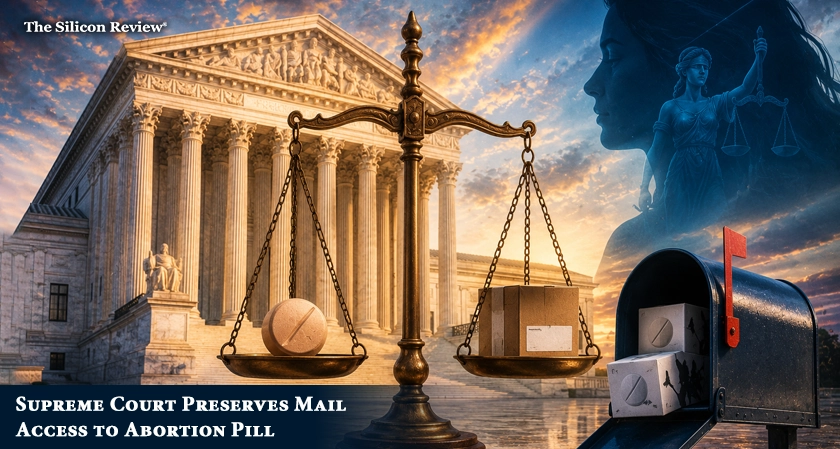
US Supreme Court news: Justices blocked a Fifth Circuit ruling that would have ended mail delivery of mifepristone nationwide. The Silicon Review reports on the indefinite stay preserving abortion pill access.
The Supreme Court blocked a lower court ruling that would have ended mail-order access to the abortion pill mifepristone, preserving the status quo while a legal challenge from Louisiana moves forward.
In a brief order issued from the shadow docket, the justices indefinitely stayed a unanimous May 1 decision by the U.S. Court of Appeals for the Fifth Circuit that reinstated an in-person dispensing requirement for the drug. The Fifth Circuit had ruled that the FDA's 2023 rule eliminating the in-person mandate was likely "arbitrary and capricious" and lacked adequate scientific support.
The court's action means patients can continue receiving mifepristone by mail or at retail pharmacies nationwide, including in states where abortion remains legal. While the justices did not explain their reasoning, Justices Clarence Thomas and Samuel Alito dissented.
Thomas called the drug manufacturers' operation a "criminal enterprise" and invoked the Comstock Act, an 1873 law banning mailing of abortion-related materials. Alito accused the companies of participating in an "unlawful conspiracy" to undermine Louisiana's near-total abortion ban, claiming that out-of-state prescribers are causing approximately 1,000 illegal abortions monthly in Louisiana.
The case, Danco Laboratories v. Louisiana, stems from a 2025 lawsuit by Louisiana challenging FDA's 2023 Risk Evaluation and Mitigation Strategy modification. The state argued that mail-order access undermines its abortion ban and imposes unrecoverable Medicaid costs for complications.
Medication abortion accounts for nearly two-thirds of all U.S. abortions, with mifepristone used in the vast majority of cases. The court's indefinite stay likely preserves access until at least June 2027, assuming no further action by Congress or the FDA.
The ruling marks the second time the Fifth Circuit has attempted to restrict mifepristone access; the Supreme Court unanimously rejected a similar challenge in 2024 on standing grounds.
As the Supreme Court indefinitely blocks the Fifth Circuit's ruling that would have ended mail delivery of the abortion pill nationwide, The Silicon Review examines how this shadow docket decision preserves access to mifepristone for millions of American women and why the legal battle over medication abortion is far from over.
Q: US Supreme Court news about abortion pill?
A: The Supreme Court indefinitely blocked a Fifth Circuit ruling that would have ended mail-order access to mifepristone nationwide, preserving current access while Louisiana's lawsuit proceeds.
Q: Why did Louisiana sue the FDA over the abortion pill?
A: Louisiana sued in 2025, claiming the FDA's 2023 rule eliminating in-person dispensing requirements undermines the state's near-total abortion ban and costs the state millions in Medicaid expenses for complications.
Q: Which Supreme Court justices dissented from the abortion pill ruling?
A: Justices Clarence Thomas and Samuel Alito dissented. Thomas called the drug manufacturers a "criminal enterprise" under the Comstock Act, while Alito accused them of participating in an "unlawful conspiracy."
Q: How long will the abortion pill remain available by mail after this ruling?
A: The indefinite stay likely preserves mail access until at least June 2027, assuming no further action by Congress or the FDA, while the case is fully litigated.
Q: What percentage of US abortions use medication abortion?
A: Medication abortion accounts for nearly two-thirds of all U.S. abortions, with mifepristone used in the vast majority of cases.
Q: Is this the first time the Supreme Court has considered mifepristone restrictions?
A: No. In 2024, a unanimous Supreme Court rejected a similar challenge from anti-abortion groups and doctors, ruling they lacked standing to sue.