>>
Platform>>
Google>>
Google Develops Merkle Tree Ce...Google Develops Merkle Tree Certificates for Quantum-Resistant HTTPS in Chrome
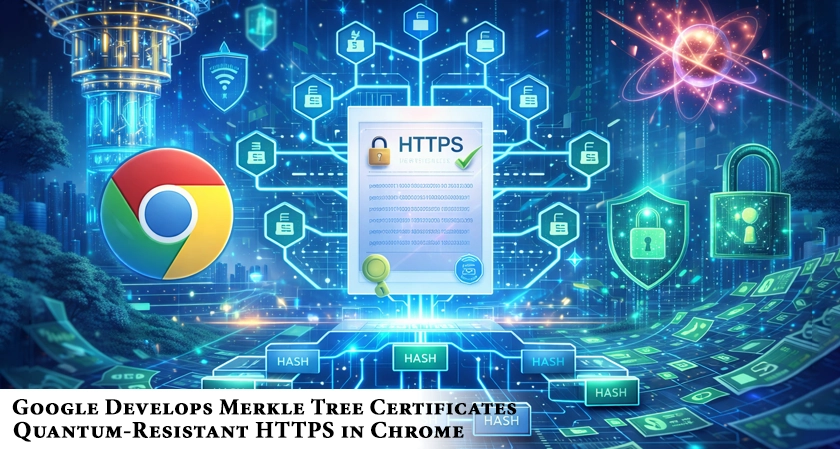
Google announced Merkle Tree Certificates (MTCs) for Chrome, enabling quantum-resistant HTTPS without performance loss.
Google has unveiled a new cryptographic system for Chrome that prepares HTTPS certificates for the era of quantum computing without sacrificing web performance. The technology, called Merkle Tree Certificates (MTCs), addresses a critical vulnerability: quantum computers running Shor's algorithm could eventually crack today's RSA and ECC encryption, enabling attackers to forge certificates and impersonate legitimate websites.
The challenge has been size. Post-quantum cryptographic material is approximately 40 times larger than current certificates swelling from 64 bytes to roughly 2.5 kilobytes per certificate. This would dramatically slow TLS handshakes and risk user abandonment of security features. Google's solution leverages Merkle tree structures, where a certificate authority signs a single "Tree Head" representing millions of certificates, and browsers receive only a lightweight proof of inclusion. This compresses the data back to approximately 64 bytes.
MTCs also embed transparency directly into issuance. Unlike today's system where Certificate Transparency adds separate overhead, MTCs make public logging a fundamental property certificates cannot be issued without appearing in a verifiable tree. This eliminates the risk of rogue certificates like those issued in the 2011 DigiNotar breach.
Google has implemented MTCs in Chrome and partnered with Cloudflare to test approximately 1,000 TLS certificates on live internet traffic, with each MTC connection backed by traditional X.509 certificates as a fail-safe. The Internet Engineering Task Force has formed the PLANTS working group to standardize the technology with industry partners.
Deployment follows a three-phase timeline. Phase one, currently underway, involves feasibility testing with Cloudflare. Phase two, scheduled for Q1 2027, will invite qualified Certificate Transparency log operators to bootstrap public MTCs. Phase three, targeted for Q3 2027, will establish the Chrome Quantum-resistant Root Store (CQRS) a new trust framework dedicated solely to MTCs, operating alongside the existing Chrome Root Program for a managed transition .
Beyond cryptography, the transition introduces governance modernization: ACME-only workflows, streamlined revocation focused on key compromise, and continuous, externally verifiable oversight replacing annual audits. Google views MTC adoption as "a critical opportunity to ensure the robustness of the foundation of today's ecosystem" and accelerate post-quantum resilience for all web users.