>>
Industry>>
Clean energy>>
EU Carbon Tax Could Cost Farme...EU Carbon Tax Could Cost Farmers €39 Billion as Fertilizer Crisis Deepens
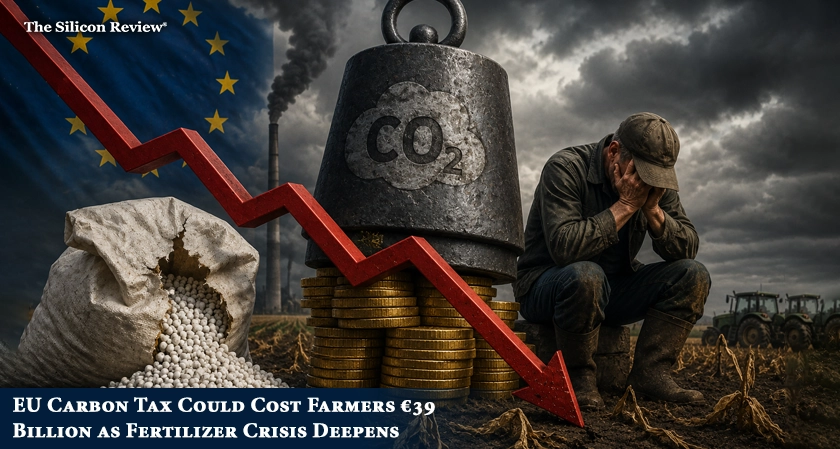
The EU carbon tax on fertilizers is set to cost farmers €39bn by 2034 as the Iran war worsens price pressures. The Silicon Review reports on Copa Cogeca's warning and the bloc's fertilizer crisis.
The EU carbon tax, formally known as the Carbon Border Adjustment Mechanism (CBAM), could cost European farmers up to €39 billion over seven years, according to Copa Cogeca, the umbrella organization representing EU farmers and agri-cooperatives.
CBAM entered its definitive phase on January 1, 2026, requiring importers of carbon-intensive goods including fertilizers to purchase certificates reflecting the embedded emissions of their products. The first certificate price was set at €75.36 per tonne of CO₂ equivalent, benchmarked to EU Emissions Trading System auction prices.
Around 30% of nitrogen fertilisers used in the EU are imported, making the agricultural sector highly exposed to the new levy. Copa Cogeca estimates that in 2026 alone, CBAM will add approximately 15% to fertiliser prices, costing farmers €820 million this year, rising to €3.4 billion annually by 2034.
The fertilizer crisis has been severely aggravated by the ongoing Iran war and the closure of the Strait of Hormuz, which has disrupted global energy markets and pushed up natural gas prices the primary feedstock for nitrogen fertiliser production. Urea prices have already climbed to approximately €800 per tonne in recent weeks.
Farmers argue that CBAM creates a structural imbalance: fertiliser costs are increasingly driven by policy-driven charges while agricultural output prices remain set on competitive global markets. "This structural imbalance is dangerous for both food security in the EU and the long-term sustainability of European agriculture," Copa Cogeca warned.
The European Commission has acknowledged the pressure. It has proposed temporarily suspending WTO most-favoured-nation tariffs on ammonia and urea imports to reduce the impact, and has set a lower 1% markup on default emissions for fertilisers compared to other CBAM sectors. However, Commissioner for Agriculture Christophe Hansen has resisted calls to suspend CBAM entirely, warning that doing so would risk worsening the EU's dependency on fertiliser imports.
The Commission is expected to present a Fertiliser Action Plan on May 19, 2026, which will include short-term and structural measures to improve availability and affordability, strengthen EU production capacity, and promote low-carbon fertilisers. Meanwhile, the EU has also proposed loosening state aid rules to allow member states to cover up to 50% of additional costs linked to the Iran crisis.
As the EU carbon tax adds €39 billion in potential costs for European farmers while the Iran war worsens the fertilizer crisis, The Silicon Review examines whether Brussels will bend to growing political pressure or if European agriculture is headed for a structural transformation it cannot afford.
Q: What is the EU Carbon Border Adjustment Mechanism (CBAM) and how does it affect farmers?
A: CBAM is a carbon tax on imports of carbon-intensive goods into the EU, including fertilizers. It requires importers to purchase certificates based on the embedded emissions of their products. For farmers, this raises fertilizer costs by an estimated 15% in 2026 alone.
Q: How much will the EU carbon tax cost European farmers?
A: Copa Cogeca estimates the direct cost of CBAM at €820 million in 2026, rising to €3.4 billion by 2034. Over seven years, the direct cost would be approximately €12 billion. If EU fertilizer producers raise prices in response, the total could reach €39 billion.
Q: How has the Iran war affected fertilizer prices in Europe?
A: The Iran war and closure of the Strait of Hormuz have disrupted global energy markets, driving up natural gas prices the primary feedstock for nitrogen fertilizer production. Urea prices have climbed to approximately €800 per tonne, adding to the pressure from CBAM.
Q: Is the European Commission considering suspending CBAM for fertilizers?
A: Commissioner for Agriculture Christophe Hansen has resisted calls to suspend CBAM, warning that doing so would risk worsening the EU's dependency on fertilizer imports. However, the Commission has proposed suspending WTO tariffs on ammonia and urea and set a lower 1% markup for fertilizers compared to other CBAM sectors.
Q: What is the EU's Fertiliser Action Plan and when will it be released?
A: The European Commission is expected to present a Fertiliser Action Plan on May 19, 2026. The plan will include short-term and structural measures to improve fertilizer availability and affordability, strengthen EU production capacity, and promote low-carbon fertilizers.
Q: Why are European farmers opposing CBAM?
A: Farmers argue CBAM creates a structural imbalance: fertilizer costs rise due to policy-driven charges while crop prices remain set on global markets. With margins already thin, many farmers say they cannot absorb these additional costs without threatening food production and rural livelihoods.