>>
Women-in-Power>>
Women in Power>>
Nirmala Sitharaman: India's Re...Nirmala Sitharaman: India's Record-Breaking Finance Minister Navigates Global Headwinds
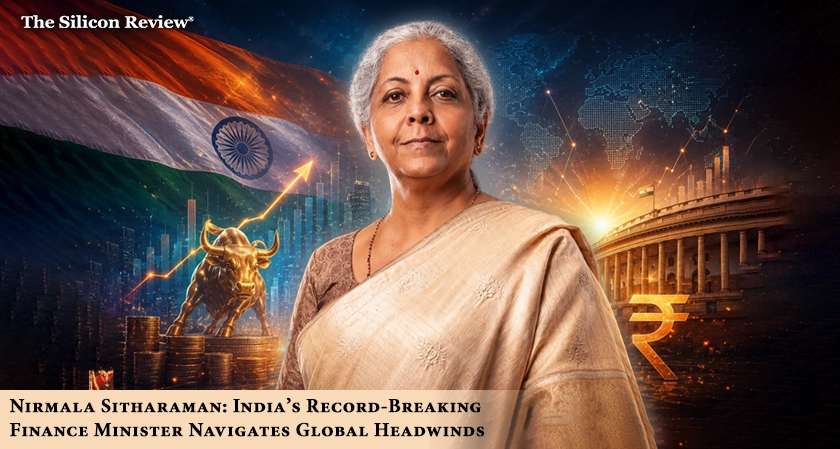
When Indian finance minister Nirmala Sitharaman stood up to present the Union Budget on February 1, 2026, she did something no finance minister in Indian history had ever done. She delivered her ninth consecutive budget breaking the record for the longest continuous tenure in the position. The moment was not lost on those watching.
Here was a woman from a modest Tamil Nadu family, who once sold fish by the roadside to make ends meet, now single-handedly steering the world's fifth-largest economy through its most turbulent period since the 1991 crisis. The critics had said she would be a placeholder. They said she was appointed because she would not challenge the establishment. They said her budgets would be routine, her reforms timid. Nine budgets later, they are not saying that anymore.
From Madurai to North Block: A Journey against the Odds
Who is Nirmala Sitharaman? Sitharaman was born in 1959 in Madurai, Tamil Nadu, into a family that valued education above all else. Her father worked for the Indian Railways, & the family moved frequently a peripatetic childhood that taught her adaptability and resilience.
What is Nirmala Sitharaman's educational qualification? She studied economics at Seethalakshmi Ramaswami College in Tiruchirappalli, & then earned a master's degree in economics from Jawaharlal Nehru University in Delhi, where she was exposed to the full spectrum of Indian political & economic thought. A PhD was in progress, but life intervened she married, moved to London, worked briefly as a senior manager in the agricultural division of the British Broadcasting Corporation, & returned to India in 1991.
Her entry into politics was unplanned. She joined the BJP as a party worker, not as a candidate. She served as a national spokesperson, appearing on television debates where her command of economics & her calm, reasoned demeanor cut through the chaos. She was good. Too good to remain behind the scenes. In 2014, she was elected to the Rajya Sabha. In 2017, she became India's first full-time female Defence Minister only the second woman to hold that portfolio after Indira Gandhi. And in 2019, she was handed the finance portfolio, perhaps the toughest job in the government.
Nine Budgets, One Vision: Reform, Invest, Grow, the Woman Who Refused to Be a Figurehead
Sitharaman's first budget in July 2019 came at a difficult time. The economy was slowing. Corporate tax rates were uncompetitive. Investment was stagnating. And she had to deliver results without the political capital that comes from an electoral mandate she was appointed finance minister after the general election, not before.
She cut corporate taxes sharply from 30% to 22% for existing companies & from 25% to 15% for new manufacturing firms. The move was bold, unexpected, & effective. Within months, foreign investment began flowing back into India.
Her subsequent budgets built on that foundation. She launched the National Infrastructure Pipeline, a $1.4 trillion plan to build roads, ports, railways, & airports across the country. She expanded the Production-Linked Incentive scheme to cover 14 sectors, turning India into a manufacturing destination for electronics, pharmaceuticals, & automobiles.
What did Budget 2026 announce for MSMEs? In her February 2026 budget, titled the "Yuva Shakti Budget" (Youth Power Budget), she announced:
- ₹10,000 crore for biopharma research - This is specifically for accelerating India's vaccine and drug development capacity
- A ₹10,000 crore MSME Growth Fund - providing venture capital to small businesses that have never had access to institutional funding
- India Semiconductor Mission 2.0 - building on the $10 billion incentive package for chip manufacturing announced in 2021
- A new tax regime with zero income tax for earnings up to ₹5 lakh - putting money directly into the pockets of low-income workers
"Every decision," she said in her budget speech, "has been guided by three principles: Ease of living, ease of doing business, and fiscal prudence."
Managing the Perfect Storm
Sitharaman's real test has come in 2026. She is managing India's economy through multiple simultaneous pressures that would have broken a lesser finance minister.
How did Nirmala Sitharaman respond to rising oil prices? The Iran War: Oil prices have surged past 90 per barrel, threatening to widen India′s current account deficit & stoke inflation. India imports 1.2 billion annually. Sitharaman has responded by cutting excise duties on petrol and diesel, reducing the burden on consumers, and accelerating India's strategic petroleum reserve expansion.
The IT Sector Slowdown: India's $315 billion IT services industry accounts for approximately 8% of India's GDP (Gross Domestic Product the total value of everything the country produces). It employs nearly 5.9 million people, mostly young graduates in cities like Bengaluru, Hyderabad, Pune, & Chennai.
The Nifty IT index a stock market measure of top IT companies has fallen 25.4% in 2026 alone. That decline has erased approximately $115 billion in market capitalization (the total value of these companies as measured by their stock prices).
US-China Trade War: The decoupling of the world's two largest economies has disrupted global supply chains. Sitharaman has positioned India as a neutral alternative the "China plus One" strategy courting companies shifting production out of China while maintaining strategic autonomy.
Domestic Demand Slump: Private consumption, which drives 55% of India's GDP, has been sluggish due to high inflation and stagnant rural wages. Sitharaman has responded with targeted cash transfers, increased spending on rural infrastructure, and a focus on job creation through manufacturing.
The Fiscal Tightrope
What makes Sitharaman's performance remarkable is her ability to balance competing priorities that seem impossible to reconcile.
She must stimulate growth without triggering runaway inflation. She must increase spending on infrastructure and social programs while keeping the fiscal deficit under control. She must support domestic industry while opening Indian markets to global competition. She must be responsive to political pressures while maintaining economic credibility with international investors. And she has done all of this without losing her temper, without blaming her predecessors, and without retreating from the reforms she believes in.
In her February 2026 budget speech, she said: "The Reform Express is well on its way and will maintain its momentum. We will not be derailed by short-term challenges or political distractions." The markets believed her. The rupee stabilized. Foreign institutional investors returned to Indian equities. The International Monetary Fund upgraded India's growth forecast for 2026 to 6.8% the highest among major economies.
What Makes Her Different
Ask economists what sets Sitharaman apart, and they point to three qualities.
First, her grasp of detail. She has read every budget document before presenting it. She can debate tax policy with chartered accountants, trade agreements with commerce ministry officials, & monetary policy with the Reserve Bank Governor. She does not rely on briefs prepared by others. She prepares her own.
Second, her political courage. She has taken on powerful interest groups from the farm lobbies that opposed agricultural reform, to the state governments that resisted GST rationalization, to the corporate houses that benefited from tax exemptions. She has not backed down.
Third, her communication skills. In a government where ministers often speak in vague generalities, Sitharaman speaks in specifics. She uses numbers. She cites data. She explains trade-offs. And she does so in English, Tamil, Hindi, & Telugu reaching audiences across India's linguistic and cultural diversity.
A Woman in a Man's World
Sitharaman works in a ministry that has historically been dominated by men. She sits across the negotiating table from male finance ministers from other countries, male governors of central banks, male chief executives of global corporations. She has never asked for special treatment & she has never needed it.
When male colleagues talk over her, she finishes her sentence anyway. When journalists ask if being a woman makes her job harder, she deflects: "The work is the work. Gender is not part of the calculation."
But younger women in the finance ministry see it differently. They see a woman who has broken through ceilings they had assumed were unbreakable. They see a role model who does not posture or preach, who simply does the job & does it well. And they see a path forward that did not exist before she walked it.
The Legacy She Is Building
If Sitharaman serves out her full term, she will have been India's finance minister for longer than anyone in history. She will have overseen the transformation of India from a fragile, high-debt, low-growth economy in 2019 to a confident, investment-friendly, fast-growing economy in the late 2020s. But her legacy is not just economic. It is symbolic. She has shown that a woman can hold the toughest job in Indian government the job that has broken the careers of male politicians for decades & not just survive but thrive.
She has normalized the idea of a female finance minister to the point where it no longer seems remarkable. And that, perhaps, is her greatest achievement: making it possible for the next woman to be judged not by her gender, but by her budget. As India's record-breaking finance minister presents her ninth consecutive budget, The Silicon Review profiles the woman from Madurai who is navigating the world's fifth-largest economy through war, inflation, & trade wars & doing so with a calm competence that has silenced critics who once dismissed her as a figurehead.
What is Nirmala Sitharaman's connection to Tamil Nadu? Nirmala Sitharaman's Tamil Nadu Connection: Born in Madurai, Sitharaman has maintained strong ties to her home state. She speaks fluent Tamil & often references Tamil literature & culture in her public addresses. Her educational foundation was built at Seethalakshmi Ramaswami College in Tiruchirappalli, & she has advocated for development projects in Tamil Nadu including the Chennai Metro expansion & the Kanyakumari port modernization.
Q: Who is the current finance minister of India?
A: Nirmala Sitharaman is the current Finance Minister of India. She has held the position since 2019 & has presented nine consecutive budgets, the longest continuous tenure in Indian history.
Q: How many budgets has Nirmala Sitharaman presented?
A: Nirmala Sitharaman has presented nine budgets as of May 2026 the most by any finance minister in a single continuous term. She presented her first budget in July 2019 & her ninth in February 2026.
Q: Where was Nirmala Sitharaman born?
A: Nirmala Sitharaman was born in Madurai, Tamil Nadu, in 1959. She grew up in a family that frequently moved due to her father's job with the Indian Railways.
Q: What is Nirmala Sitharaman's educational qualification?
A: She holds a master's degree in economics from Jawaharlal Nehru University in Delhi. She also studied at Seethalakshmi Ramaswami College in Tiruchirappalli & was pursuing a PhD before she married & moved to London.
Q: What portfolios has Nirmala Sitharaman held in the government?
A: She has served as India's Defence Minister (the first full-time female Defence Minister), Minister of Commerce and Industry, and Minister of Finance and Corporate Affairs.
Q: What was the highlight of Budget 2026?
A: The February 2026 budget, titled the "Yuva Shakti Budget," included a ₹10,000 crore biopharma fund, a ₹10,000 crore MSME Growth Fund, the India Semiconductor Mission 2.0, and a tax regime with zero income tax for earnings up to ₹5 lakh.
Q: What did Nirmala Sitharaman do to control fuel prices?
A: She cut excise duties on petrol and diesel to reduce the burden on consumers when global oil prices surged past $90 per barrel due to the Iran war. She also accelerated India's strategic petroleum reserve expansion.
Q: Is Nirmala Sitharaman married?
A: Yes, she is married to Parakala Prabhakar, an economist & former advisor to the Government of Andhra Pradesh. They have one daughter.
Q: What is Nirmala Sitharaman's net worth?
A: According to her 2024 election affidavit, her movable & immovable assets are valued at approximately ₹1.8 crore (about $215,000). She owns no car & has no criminal cases registered against her.
Q: How long has Nirmala Sitharaman been Finance Minister?
A: She assumed office on May 31, 2019, and has served continuously for seven years as of May 2026 longer than any other finance minister in India's history.