>>
Women-in-Power>>
Women in Power>>
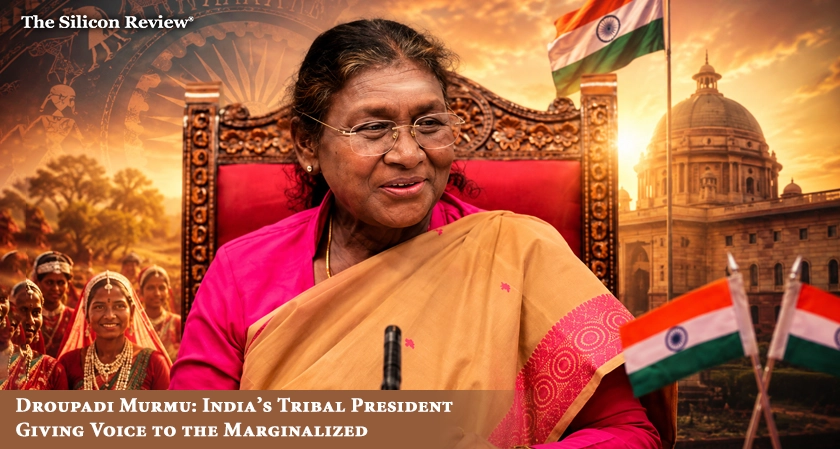
Droupadi Murmu: India's Tribal...Droupadi Murmu: India's Tribal President Giving Voice to the Marginalized
The Silicon Review
12 May, 2026
Author:
Sashindra Suresh
In the heart of Odisha's Mayurbhanj district lies Uparbeda, a small village without paved roads or reliable electricity. It is not the kind of place that usually produces presidents. But it produced Droupadi Murmu. She was born into a Santhal tribal family in 1958, the daughter of a farmer who struggled to put food on the table. There was no legacy of power. No family fortune. No political dynasty waiting to launch her career. There was only a girl who refused to believe that where you start determines where you finish. When Murmu took the oath as 15th President of India in July 2022, she became not just the second woman to hold the office, but the first tribal leader and the first person from Odisha to sit in Rashtrapati Bhavan. For a nation of 1.4 billion people, it was a moment of profound symbolism. For India's 104 million tribal citizens, it was proof that the highest office in the land could belong to one of their own.
She walked through hell while alive, The Path Was Never Easy. She Walked It Anyway.
Murmu's journey to Raisina Hill was not a straight line. It was a path marked by loss that would have broken most people. She lost her husband in 2014. Then her mother. Then her father. Then her younger son all within a span of just a few years. She also lost a son earlier, as a child. A lesser soul would have retreated from public life, seeking shelter in private grief. Murmu did the opposite. After a brief hiatus, she returned to public service with a quiet resolve that those who know her describe as her defining trait: the ability to absorb pain and convert it into purpose. She did not speak publicly about her grief. She simply got back to work. That work had already been considerable. She had served as a legislator in Odisha. She had held a ministerial portfolio, managing transport and commerce not the glamorous assignments, but the kind that actually affect people's daily lives. She had served as Governor of Jharkhand, a state with a significant tribal population, where she earned a reputation for fairness and accessibility. When her party, the Bharatiya Janata Party, proposed her name for the presidency, few outside Odisha knew who she was. The opposition questioned whether she was qualified. The media speculated about whether she would merely be a figurehead. Then she opened her mouth. And India listened.
A President of India Who Refuses to Be Ceremonial
India's presidency is largely a constitutional role, with the real executive power resting with the Prime Minister and the Cabinet. But Murmu has discovered that moral authority operates independently of legal authority. From the start, she used the platform to draw attention to the issues that the powerful prefer to ignore: the plight of tribal communities displaced by development projects, the erosion of forest rights, and the educational and economic marginalization of Adivasi populations. She did not issue fiery speeches or confront the government directly. She simply invited tribal leaders to Rashtrapati Bhavan. She listened. And where she could, she acted.
In January 2026, during her address to Parliament on the eve of Republic Day, Murmu delivered a message that resonated far beyond the chamber. She announced the "Viksit Bharat-G RAM G law," guaranteeing 125 days of rural employment annually an unprecedented expansion of India's social safety net that had been negotiated behind the scenes without public fanfare. She also spotlighted India's manufacturing milestones, noting that smartphone exports had crossed ₹1 lakh crore & that electric vehicle exports now reach over 100 countries. But she balanced these achievements with a reminder of unfinished business: "Development cannot be measured only in GDP. It must be measured in the dignity of the poorest."
The Voice That Cannot Be Ignored
What makes Murmu remarkable is not her power to command she has relatively little but her power to convene, to elevate, and to insist. When she speaks, she does not shout. She does not need to. She speaks in the measured tones of someone who has buried children and still found reasons to serve. Her voice carries the weight of lived experience, and Indian politicians have learned that ignoring her comes at a political cost.
She has used her platform to advocate for tribal education, for the preservation of tribal languages, and for economic opportunities that do not require Adivasis to leave their ancestral lands. She has hosted dinners for sanitation workers, recognizing their labor in a way that previous occupants of Rashtrapati Bhavan had not thought to do.
She has also been a steady presence during India's multiple crises: the Iran war's impact on oil prices, the economic slowdown that has hit rural India hard, and the political polarization that has marked Indian democracy in recent years. She has remained above the fray, not by withdrawing from it, but by refusing to be dragged down by it.
What She Means for India's Tribal Communities
India is home to over 700 tribal communities, speaking more than 300 languages. They are among the country's most marginalized populations, with lower literacy rates, higher poverty rates, and weaker access to healthcare than the national average. For generations, they have been promised inclusion. They have been promised representation. They have been promised that their voices would be heard.
Murmu is the first tribal leader to sit in the President's chair. But she is determined not to be the last.
During her tenure, she has quietly mentored a generation of young tribal women, encouraging them to enter public service, to pursue higher education, and to refuse the limitations that society tries to place on them. She does not speak about this work publicly. It is known only through the young women she has helped now scattered across government offices, law schools, and grassroots organizations who credit her with believing in them when no one else did.
The Presidential Legacy That Is Still Being Written
Murmu's term as President will end in 2027, barring an extension. She will leave behind a record of quiet effectiveness, of dignity under pressure, and of unwavering commitment to those who have no voice in the corridors of power. But her true legacy will not be measured in legislation or executive orders. It will be measured in the young tribal girl in a small village in Odisha who now knows for the first time that the highest office in the land does not belong to someone from another world. It belongs to someone who could be her.
"I had no idea that someone like me could become President," a young Santhal woman told a reporter in Murmu's home district. "Now I know. And I will never forget." That is not a sound bite. It is a revolution. And it began with a woman who refused to believe that her village, her gender, or her origins could determine her destiny. As India's first tribal President and only the second woman to hold the office, Droupadi Murmu is redefining what leadership looks like in the world's largest democracy not with power, but with presence; not with speeches, but with silence that speaks volumes.